About
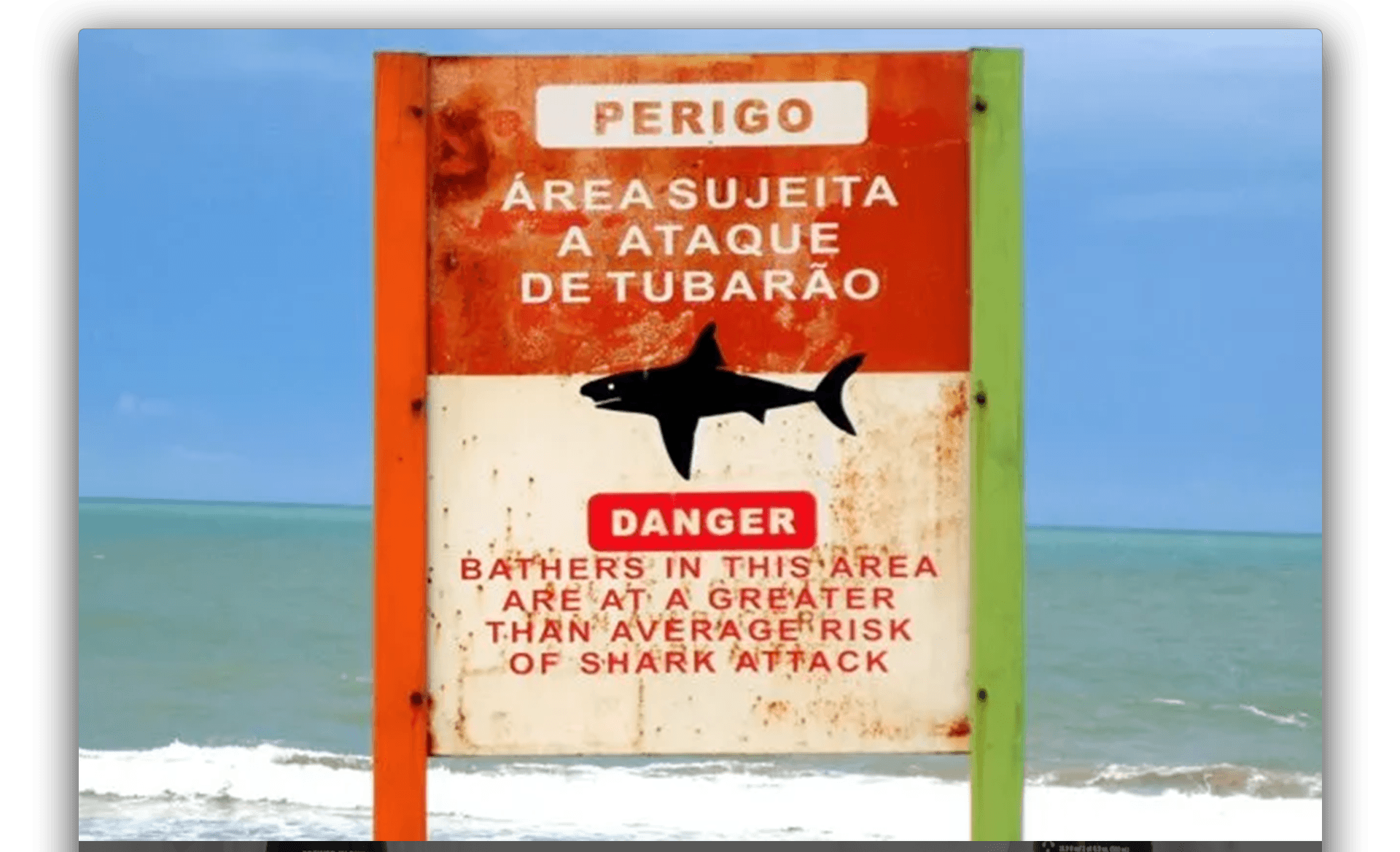
The project was designed to warn about the appearance of sharks on the coast and raise awareness about attacks, avoiding any form of disturbance to the animal and also becoming a cultural attraction for the city.
Project
This project was developed in a postgraduate course at CESAR School in partnership with designers: Guilherme Cahú, Gabriela Padilha, Victória Lopes e Junior Melo.
Methods and techniques
Desk Research, Lotus Diagram, crazy eights, Round Robin and mid-fidelity prototype.
Tools
Miro, modeling clay, Arduino board, LED lights, paper and pen.
Discovery
Every now and then shark attacks on the beaches of Recife and the Metropolitan Region become topics of debate. A problem that has plagued the population for more than two decades and which does not seem to find a solution that is beneficial for swimmers and animals.
With this in mind, we sought to better understand the problem and try to find a way to raise awareness among bathers and make the beach environment safer for everyone.

There are at least 3 attacks per month on the city's coast (Newspaper headlines are in Portuguese)
Understand
After desk research on the topic, we analyzed market solutions implemented in other locations that experienced the same problem:
- Magnetic deterrents (bracelets with magnet)
- Scented board wax (clove or pepper oil)
- Sound devices (predators like killer whale)
- Camouflage clothing (imitates poisonous prey)
- Chemical repellents (dead shark smell)
But what do these solutions have in common?
They are expensive: Generally paid in dollars; They are not effective: They cover a radius of up to 1m and do not stop the shark; They irritate the animal: High risk of losing a limb.
Public actions
Currently in the State, CEMIT (State Shark Incident Monitoring Committee) has used some methods that are not very effective in reducing attacks:
Signs of awareness: No maintenance; vandalized. Shark monitoring via chip: expensive project still underway.
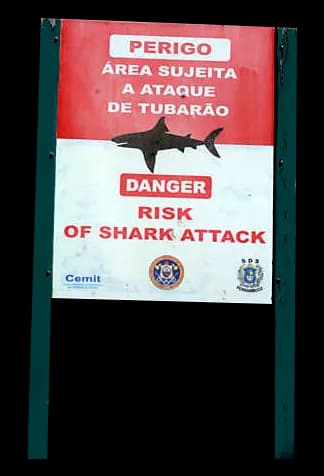
Danger signs are often ignored by swimmers
Define
Based on the data analyzed, we then set out to define a project that can meet the population's need to raise awareness about the risks and that is also a less harmful environment for sharks.
In our moment of ideation, we sought to use methods that would give us an overview of how the beach is used by the population so that our solution would not directly interfere with this cultural moment in Recife. And, based on awareness of how the beach is used, we move on to the next steps.
Lotus Diagram
At this stage we explore and organize possible solutions. With the Lotus Diagram method we realized important points to make our solution viable:
- Sensors in the sea (detect animal movement)
- Signage on the shore (warning lights)
- Screen for warnings and awareness
- Web platform (the population indicates where the animal appeared)
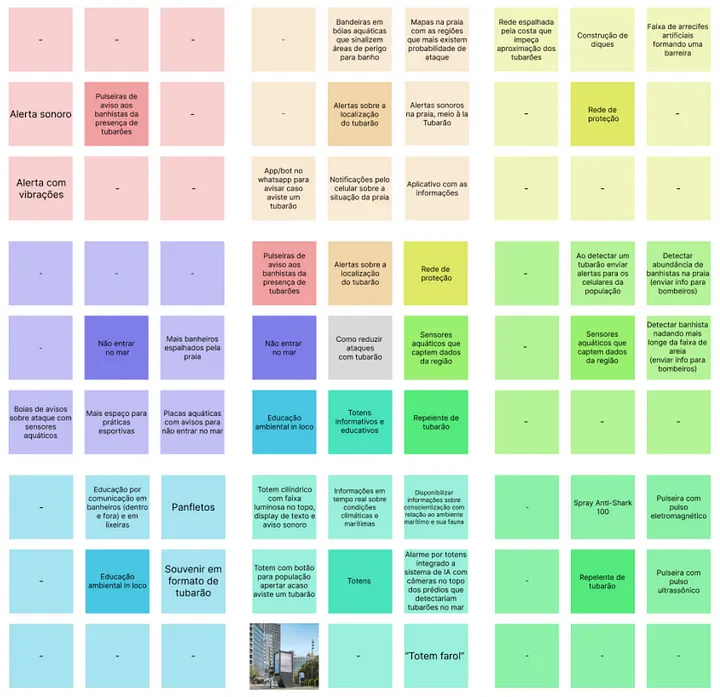
Together we fill in the diagram (The content is in Portuguese but the translation is in progress, no worry)
Thus, we defined that a totem would fulfill the functions of alerting and raising awareness among the population, in addition to being able to be reproduced on a large scale.
Ideate
We move on to idealizing the final project. We wanted something that would draw the attention of bathers and that would not only have an instructional role but also an artistic and cultural one.
We use the Crazy Eights technique in conjunction with the Round Robin method because it is a quick and visual technique to explore our ideas, in addition to being able to use the method to evolve a proposal already designed in our moment of ideation.
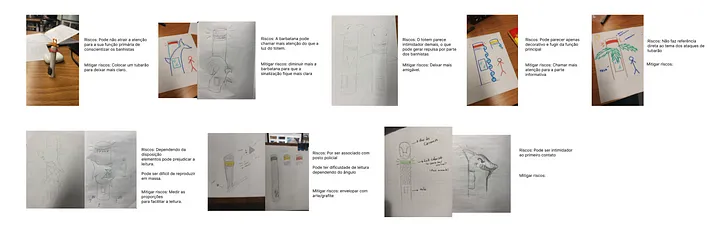
We analyze the risks of each solution proposal (The content is in Portuguese but the translation is in progress, no worry)
So we illustrated some models and, analyzing the risks of each one, we concluded by designing a modular cultural totem with a light indicator at its top.
Design
Based on the designed model, we sought to materialize the totem with modeling clay, as it is a quick and low-cost alternative. At the same time, we tested visual alerts in the electrical part of the solution, using an Arduino board and a red LED.
We were careful to balance the figures present on the totem, considering their weight, height and location on the shore. We also pay attention to the types of visual alerts so as not to cause harm to people predisposed to epileptic seizures.
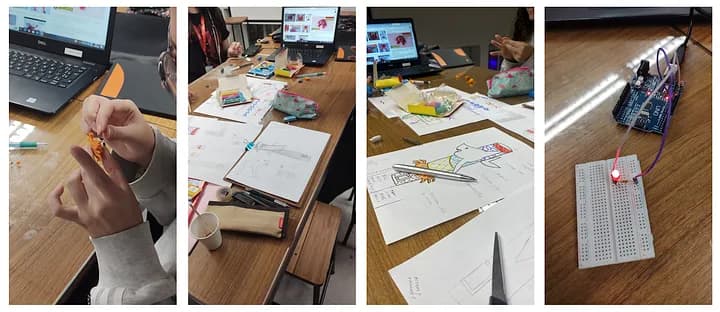
Prototyping and testing time
A yellow light indicates suitable times of day for sharks to appear. A red light indicates that a shark is swimming close to shore.
Prototype
As a final product we have a totem that works as a visual alert in case of shark detection based on monitoring carried out by sensors and tracking.
Also serving as a tourist attraction, the totem carries several elements of Pernambuco culture, inspired by movements such as the mangue beat, armorial movement, woodcuts, etc.
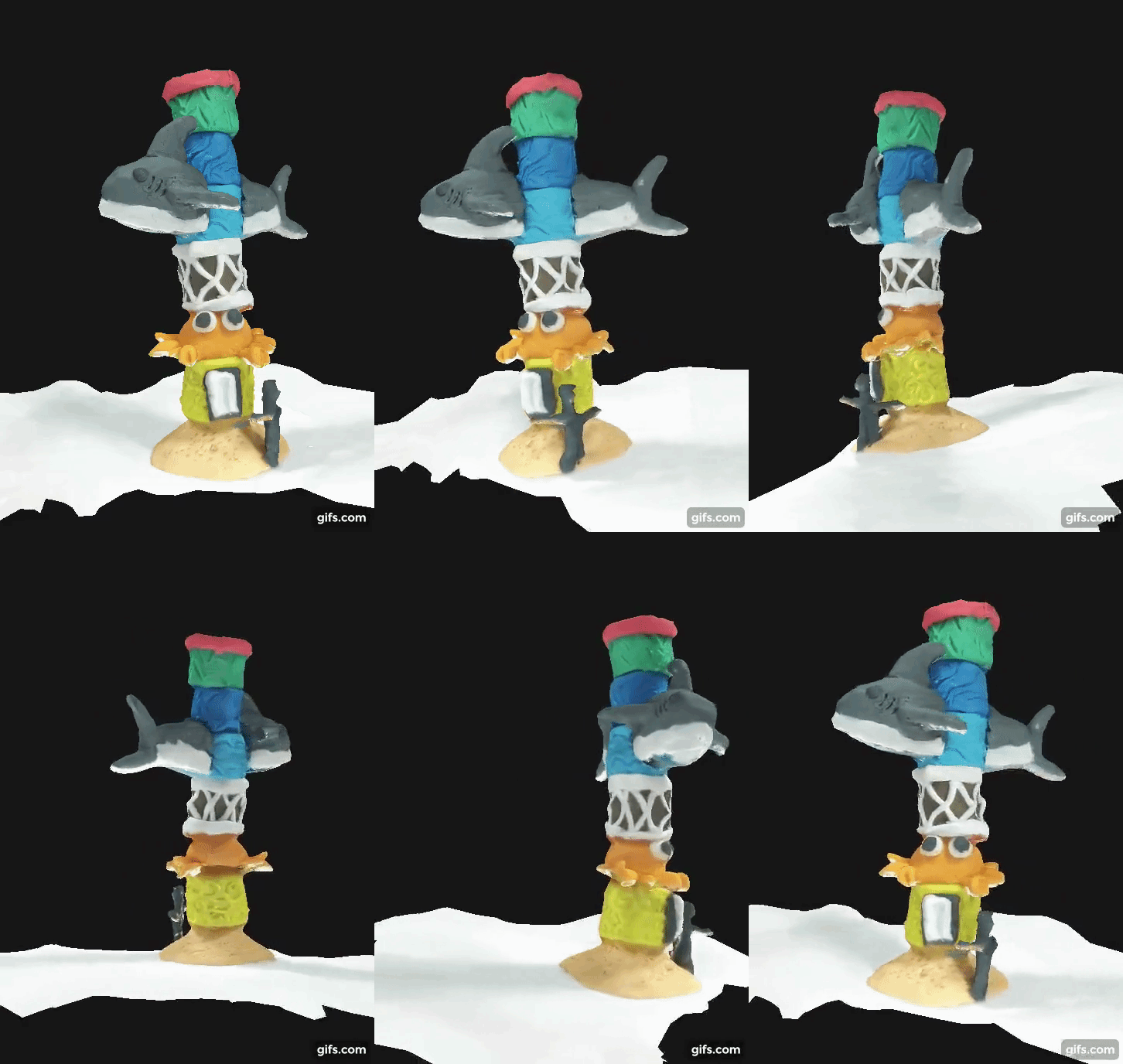
3D view of the prototype
On the screen (located at the base of the totem) various public awareness campaigns are displayed. In addition, information about tides, habits of local marine life, what to do in case of attacks, among other information, is displayed.
To consider
Due to the project's short period, we were unable to develop campaigns and information to be displayed on the totem screen, but it is something we want to work on. Another point of improvement would be the implementation of QR Codes indicating cultural exhibitions throughout the city.
Learnings
In general, we realized that the project involves a lot of the community, opening space for artists to contribute to the creation of totems and using technology to provide crucial information to prevent attacks.
Gif by Best Animations Gif
I really enjoyed the experience of working with unusual materials in my daily life, but which were very useful within the scope of the project. I will definitely explore Arduino more again, as I like to expand my prototyping options, moving away from screens and into something tangible.